
Ajax is committed to preserving its unique environmental and heritage resources. This page provides guidance for developers and builders on heritage properties, conservation requirements, and financial incentive programs.

Heritage Properties in Ajax
The Town of Ajax is home to a number of heritage properties. Many of these properties have been formally recognized by the Town either individually or as part of a Heritage Conservation District. Others have not been formally recognized but have been included on the Town’s Heritage Inventory.
The Province of Ontario established the Ontario Heritage Act in 1975 to help protect heritage properties and archaeological sites. The Act gives municipalities and the provincial government the power to identify and protect properties using various tools such as heritage registers, heritage designation, easement agreements and ownership.
The tools that are most commonly used by municipalities include:
- the creation of a Heritage Register under Section 27 of the Ontario Heritage Act;
- individual property designation under Section 29 (Part IV) of the Ontario Heritage Act; and
- Heritage Conservation District designation under Section 41 (Part V) of the Ontario Heritage Act.
These tools, as well as the identification of non-designated heritage properties, can be explored further below. Questions about matters referenced in the Ontario Heritage Act that are not addressed on this page, such as Heritage Conservation Easement Agreements and Archaeological Sites, should be forwarded to the Town’s Heritage Planner.
The Ontario Heritage Act requires that every municipality in the province keep a publicly-accessible list of heritage properties. This list, called the Heritage Register, must include all properties that are individually designated under the Section 29 (Part IV) of the Ontario Heritage Act and any Heritage Conservation Districts designated under Section 41 (Part V) of the Ontario Heritage Act.
Municipalities may also include non-designated properties on their Heritage Registers. This process is commonly known as “listing” and properties added for this purpose are referred to as “listed” properties. At the present time, the Town of Ajax Heritage Register only includes designated properties. It does not include any non-designated or “listed” properties.
The Heritage Register is currently available as Appendix A in the Town’s Official Plan.
Individual property designation under Section 29 (Part IV) of the Ontario Heritage Act can be used to protect any property that demonstrates cultural heritage value or interest. If a property meets two* or more of the nine criteria in Ontario Regulation 9/06, it can be designated. (*Note: The Province of Ontario revised the minimum requirement for heritage designation from one to two criteria on January 1, 2023.)
The primary purpose of designating heritage properties is to ensure that they are properly managed and conserved for the enjoyment of future generations. In addition to ensuring that the Town has a role in the management of a heritage property, designation also promotes knowledge and understanding about a property’s history and value.
In Ajax, there are currently 31 individually designated properties. This list includes houses, commercial buildings, places of worship, cemeteries, industrial buildings and public monuments. All designated properties can be easily identified by the presence of a designation marker.
Further information on designation is available in the Town’s Designated Heritage Properties brochure.
A Heritage Conservation District designation under Section 41 (Part V) of the Ontario Heritage Act is used to protect a group of heritage properties that, together, express heritage value. Unlike individual heritage designations under Section 29 (Part IV) of the Ontario Heritage Act that normally focus on individual buildings or structures, district designations recognize the value of physical and spatial elements such as streets, landscape features, vistas and views that overlay an entire area.
When a Heritage Conservation District is designated, the Town assumes increased responsibilities for overseeing changes, such as the construction of new buildings, the modification of existing properties or the installation of new infrastructure. Heritage Conservation Districts are not designed to prevent growth and development, but rather, to manage change and ensure that it supports and contributes to an area’s unique and special character.
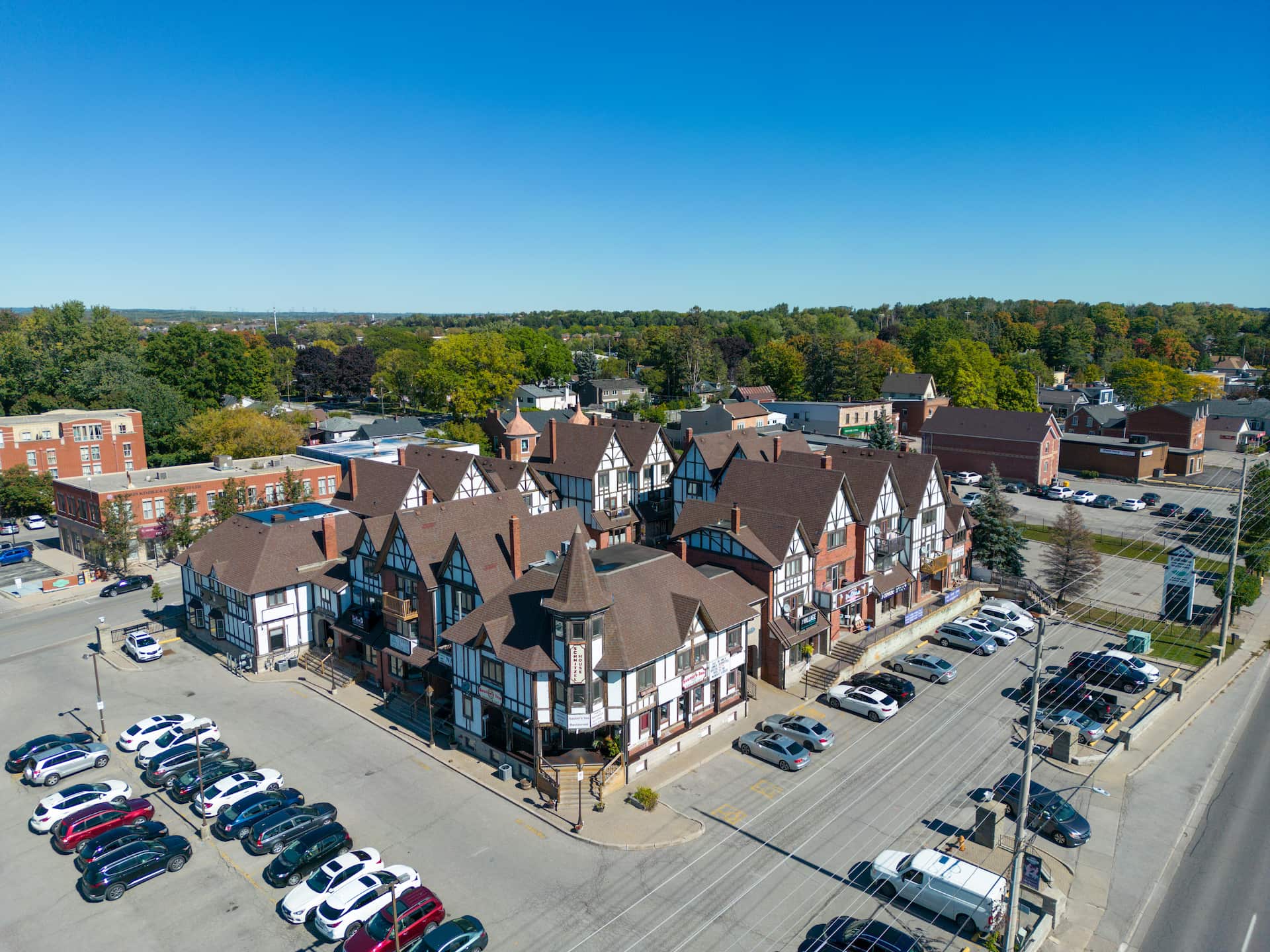
There is currently one Heritage Conservation District in Ajax. The Pickering Village Heritage Conservation District was designated in 2013 and is comprised of 58 commercial and residential properties in the Village’s central area. A comprehensive set of policies and guidelines known as the Pickering Village Heritage Conservation District Plan is designed to help ensure the conservation of the area’s heritage character.
The Town of Ajax has maintained an informal inventory of non-designated heritage properties since the 1990s. This list encompasses all properties in the Town that have been deemed to have heritage value or interest, but that have not been officially designated under the Ontario Heritage Act.
While these properties have no formal protection from demolition or alteration, they may be considered as heritage properties for the purpose of planning or development applications. If the Town wishes to exercise control over the future evolution of any one of these properties, it must proceed with having that property designated under the Ontario Heritage Act.
The Town of Ajax uses plaques and markers to identify important sites. Bronze plaques are located throughout the Town to tell the stories of significant people, places and events. Blue-coloured markers are posted at all heritage properties that have been individually designated under the Ontario Heritage Act.
Heritage Planning Resources
The Town of Ajax recognizes the importance of protecting its heritage and outlines its commitments to conservation in Section 2.6 of its Official Plan.
It requires that all new development be respectful of existing heritage properties and that development in older neighbourhoods reflect the established heritage character of those areas.
In order to ensure the continued conservation of it heritage properties, the Town uses a variety of tools and financial incentives. The various programs that are available are explored below.
A Heritage Permit is required prior to undertaking any alterations to a heritage building or property that may impact its character-defining features or attributes. For properties that are individually designated under Section 29 (Part IV) of the Ontario Heritage Act, these heritage attributes should be clearly listed in the designation by-law. For properties within a Heritage Conservation District designation under Section 41 (Part V) of the Ontario Heritage Act, the character-defining features will be listed in the District Plan. In the case of the Pickering Village, the list of heritage attributes can be found in Sections 8.3.1 and 8.3.2 of the Pickering Village Heritage Conservation District Plan.
The system for processing a Heritage Permit application is dependent upon the nature of the application. Council has delegated authority to staff for decisions on minor applications, so the turnaround time for approval can be as little as a few days. Decisions on applications of a moderate scale are generally made by staff after consultation with the Town’s Heritage Advisory Committee. Major applications are subjected to review by the Heritage Advisory Committee and a decision by Council. Regardless of the nature of the application, the Town is required under the Ontario Heritage Act to make a decision within 90 days.
There is a one-page Heritage Permit available for those looking for more information on Heritage Permits. The Heritage Permit Application Form is also available online.
Cultural Heritage Evaluation Reports may be required by the Town when development is proposed on or adjacent to a property with probable but unconfirmed heritage value. Generally, this type of property is included on the Town’s informal inventory of non-designated properties. The purpose of the Cultural Heritage Evaluation Report is to clearly document the heritage value of the property with regard to its historical, design and contextual characteristics. All reports must contain an evaluation of the subject property using Ontario Regulation 9/06, which assesses heritage value using nine criteria. If a property is demonstrated to satisfy at least two of the nine criteria, Council may choose to seek designation under the Ontario Heritage Act.
All Cultural Heritage Evaluation Reports must be completed by a qualified heritage consultant. The content of the report may be combined with a Heritage Impact Statement to form a comprehensive document that identifies a property’s value and offers mitigation options to protect that value.
A Heritage Impact Statement may be required by the Town when development is proposed on or adjacent to a designated or non-designated heritage property. The Heritage Impact Statement must describe the subject heritage property, identify the potential impacts of the proposed development, identify conservation options, and recommend impact mitigation techniques and an implementation strategy. All Heritage Impact Statements must demonstrate that the subject heritage property will not be adversely affected by the development. Review by the Town’s Heritage Advisory Committee is also required.
All Heritage Impact Statements must be completed by a qualified heritage consultant. In some cases, the content of the statement may be combined with a Cultural Heritage Evaluation Report to form a comprehensive document that identifies a property’s value and offers mitigation options to protect that value.
A Conservation Plan may be required by the Town in instances where development is anticipated to impact a designated heritage property. Unlike a Heritage Impact Statement, which primarily identifies the impacts of a development and offers mitigations options, a Conservation Plan is a finely detailed plan that outlines how the heritage attributes of a property will be conserved. This is typically done graphically through annotated site plans and elevation drawings that demonstrate where and how conservation work will be conducted. Conservation Plans should also include recommendations and timelines for future interventions and maintenance.
Where a Conservation Plan is required, it is typically included in a development agreement as a condition of approval. The Town may require securities to be posted by the developer for the value of the work outlined within the Plan. This ensures that the work is completed to the standards required by the Town.
An archaeological assessment may be required by the Town when development is proposed on or adjacent to lands containing known archaeological resources or archaeological potential. Areas of archaeological potential are typically characterized by proximity to water bodies, the presence of heritage resources or previously undisturbed soils. Where archaeological resources or archaeological potential exists, the developer must retain a consulting archaeologist holding a valid license to carry out the work. This assessment must occur prior to any demolition, grading or other soil disturbance.
There are four stages of archaeological assessment but not all stages will be necessary for each project, as archaeological potential can be cleared at any stage. Any significant archaeological resources present on a property shall be preserved on site or removed and documented to the satisfaction of all authorities.
Financial Incentive Programs
Heritage Property Tax Rebate Program
In 2006, Town Council approved a Heritage Property Tax Rebate Program designed to reduce property tax costs for designated heritage properties. The program provides a 10% rebate on the Town and Education portions of the tax bill. Property owners must apply on a yearly basis in order to receive the rebate.
Eligibility in the program is contingent upon a property being designated under the Ontario Heritage Act (either as an individual property or as part of a Heritage Conservation District) and being subject to a Heritage Easement Agreement under Section 22 or 37 of the Ontario Heritage Act. Heritage Easement Agreements are voluntary legal agreements between the Town and a property owner that establish mutually accepted conditions for ensuring preservation in perpetuity. Easements are a stronger form of protection than designation, and therefore, are required to ensure the wise investment of funds returned to the property owner through the Heritage Property Tax Rebate Program.
For more information on the Heritage Property Tax Rebate Program, please contact the Town’s Heritage Planner at heritage@ajax.ca or 905-619-2529 ext. 3200. The Heritage Property Tax Rebate Program Application Form is also available online and must be downloaded to complete.
Pickering Village Community Improvement Program
Heritage properties located in Pickering Village that are designated under the Ontario Heritage Act (either as an individual property or as part of a Heritage Conservation District) or included on the Town’s informal inventory of non-designated heritage properties may be eligible for a number of financial incentives available through the Pickering Village Community Improvement Program (CIP).
Further information regarding the Pickering Village CIP is available on the our website.
Contact
If you have questions, please contact the Town’s Heritage Planner at heritage@ajax.ca or 905-619-2529 ext. 3200.