
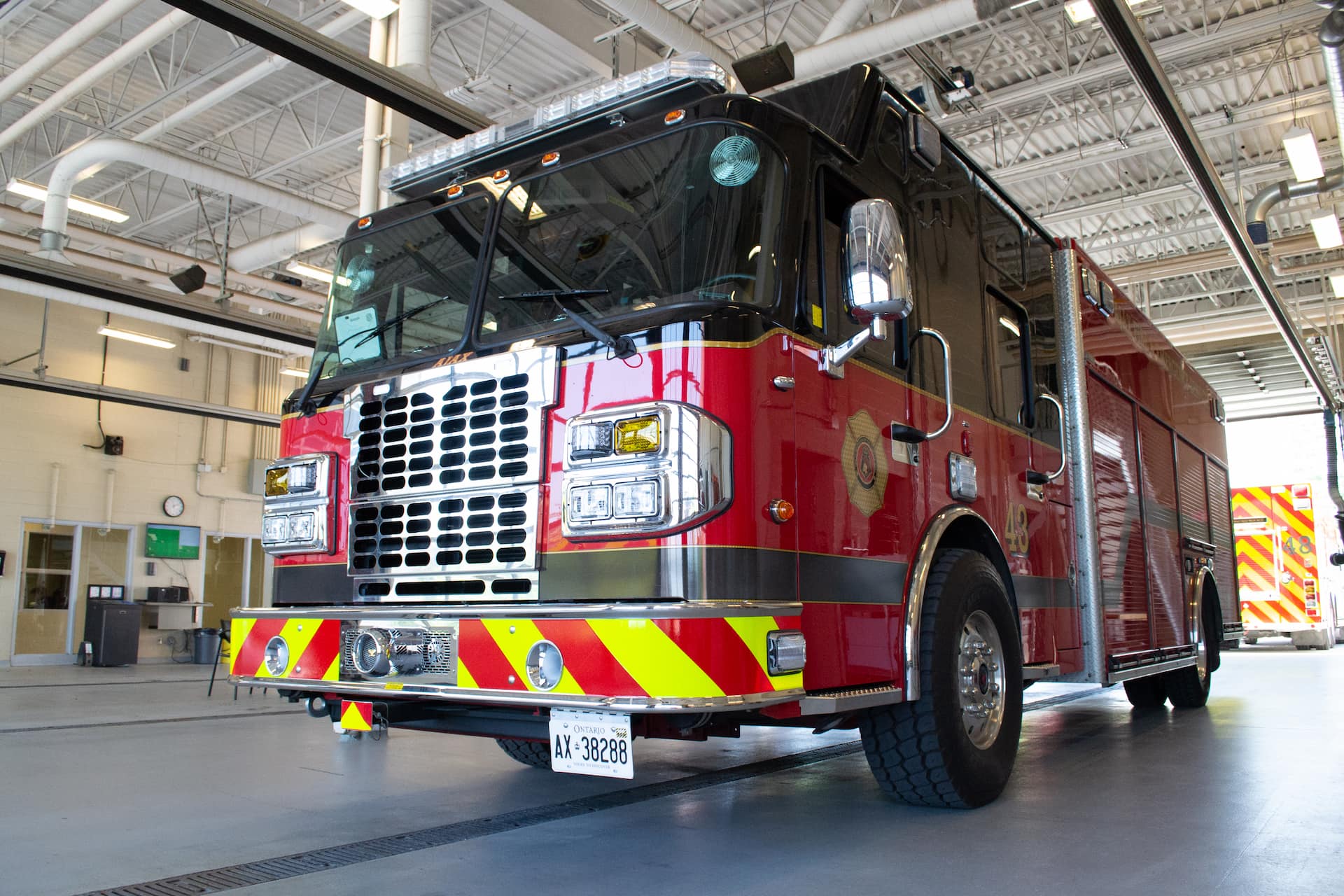
Ajax Fire and Emergency Services focuses on protecting the well-being of our community. Find information on emergency preparedness, public safety programs, and response services.
Emergency Preparation
Stay In Touch
Stay in touch with your emergency contacts and get reliable information during an emergency.
Steps for Emergency Preparedness
The Town of Ajax and the Region of Durham have programs and plans in place in the event of an emergency situation.
Plans are regularly reviewed and practised. It is important that residents, businesses and visitors are aware of the emergency plan.
- View the Town of Ajax Emergency Response Plan.
- Emergency preparedness starts at home. Make sure you and your family are ready. Visit the Region of Durham’s Emergency Preparedness webpage for more information.
- Make an emergency kit of basic items you will need.
- Stay in touch with your emergency contacts and get reliable information during an emergency.
If you live, work, play, or go to school near the nuclear plants in Clarington or Pickering, take some time to learn about nuclear response preparation.
Knowing your risks can help you and your family be prepared for an emergency. Make sure you think of risks where you live, work, learn and play. Different risks may need you to get ready in different ways. It’s a good idea to review your risks and plans each year because they might change.
These plans should include preparations for the following hazards:
- Flooding
- Severe Storms
- Power Outages
- Transportation Emergencies
To learn more visit Know your risks where you live, work and play.
Durham Region has a prioritized list of risks that apply to residents of Ajax. Visit their Know your Risks webpage for more information.
It is always a good idea to have an emergency plan. Your emergency plan should include a safe place to go. If you aren’t able to get to that safe place, you may have to go to an evacuation centre. Pets are welcome at evacuation centres, so plan for them too.
In collaboration with a range of community partners, evacuation centres are set up in a safe place provided by the municipality. At an evacuation centre, you will have access to emergency social services such as:
- Assistance to contact family members
- Clothing
- Drinking water
- Emergency information
- First-aid
- Food
- Shelter
Evacuation centres will be set up as needed.
There are many reliable forms of communications that can keep you up-to-date and well informed during an emergency.
Make sure to update your phone list often and organize your emergency contacts in your Emergency Plan.
Discuss the possibility of emergency situations with your family. Reduce stress and save valuable time during an emergency by planning ahead.
- Create an Emergency Action Plan using the Emergency Management Ontario’s online tool.
- Plan ahead for your family’s specific needs
- Prepare Emergency Survivals Kits for your home, vehicles and pets.
Whether at home or on the road, emergency kits should keep you and your family prepared for at least 72 hours. Check your kits regularly and restock them. Everyone in your family should know where to find your and your emergency kits. Remember to monitor expiry dates on food, water, medications, batteries, etc., and rotate supplies so you always keep items fresh.
- Water (four litres per person, per day – 2Litres to drink and 2Litres to clean/cook)
- First aid kit
- Personal hygiene supplies and hand sanitizer
- Flashlights
- Radio, either battery-powered or a wind-up radio
- Extra batteries, including a backup battery for your smartphone
- Important papers (emergency plan, identification, contact lists, copies of prescriptions, etc.)
- Food that won’t spoil (e.g. canned foods, energy bars) and a manual can opener
- Food preparation equipment, including knives, spoons, disposable plates and paper towels
- Special needs items, such as baby supplies (e.g. instant formula), equipment for people with disabilities, pet supplies and prescription medications
- Blankets or sleeping bags
- Seasonal items (e.g. sunscreen, sunglasses, hats, mitts, scarves)
- Money in small bills and coins
- Extra keys for your car and house
- Whistle (to attract attention, if needed)
- Zip-lock bags and garbage bags (to keep things dry)
- Playing cards, travel games, and activities for children
- Food that won’t spoil (e.g. canned foods, energy bars) and a manual can opener
- Water in heat/freezer safe packaging (two litres per person, per day)
- Blanket
- Extra clothing and shoes
- First aid kit with seat belt cutter
- Small shovel, scraper and snowbrush
- Candle in a deep can and matches
- Flashlight with extra batteries
- Whistle
- Roadmaps
- A copy of your emergency plan and personal documents
- Sand, salt or cat litter (non-clumping)
- Anti-freeze and windshield washer fluid
- Tow rope
- Jumper cables
- Fire extinguisher
- Warning light or road flares
- Blanket or bed
- Bowls that won’t tip over
- Cage or container with your name and your vet’s contact information on a label
- Cat litter and litter box
- Food and water for seven days
- Leash or harness (muzzle if needed)
- Manual can opener and plastic lids
- Medicine and copies of vet/vaccination records
- Newspaper, bedding material, paper towels, plastic bags
- Pet information including licence, tags and veterinarian information
- Photo of you with your pet, in case you get separated
- Special equipment your pet may need
- Treats and toys
Evacuation Plans
It is always a good idea to have an emergency plan.
Your emergency plan should include a safe place to go. If you aren’t able to get to that safe place, you may have to go to an evacuation centre. Pets are welcome at evacuation centres, so plan for them too.
In collaboration with a range of community partners, evacuation centres are set up in a safe place provided by the municipality.
At an evacuation centre, you will have access to emergency social services such as:
- Assistance to contact family members
- Clothing
- Drinking water
- Emergency information
- First-aid
- Food
- Shelter
Evacuation centres will be set up as needed.
Nuclear Emergencies
Prepare for a Nuclear Emergency so you know what to do!
- In the event of a nuclear emergency, directions will be passed down from the Province of Ontario, followed by the Region of Durham through to the Town of Ajax. Learn more at www.emergencymanagementontario.ca.
- If you live, work, play, or go to school within 10 kilometres of the nuclear station Pickering, there are some things you should know about for your safety. Review the Region’s Nuclear Awareness Fact Sheet for an overview.
- Public Alerting includes sirens within 3 kilometres of the nuclear station, and an automated telephone dialling system to all homes within 10 kilometres of the nuclear station. Visit the Region of Durham website for more information on the public alerting system, including scheduled siren testing.
During an emergency, you may receive directions that include:
If asked to shelter in place, you should go inside, close all windows and doors, and turn off your heating and air conditioning systems. Listen to the radio, watch the television, and look for information updates on official websites and social media channels. Be ready to leave in case you are told to.
KI (potassium iodide) can help reduce how much radioactive iodide enters your thyroid. KI pills are delivered to households and businesses within the 10-kilometre area around the nuclear stations and are available to anyone who lives within 50 kilometres of the stations. KI pills are also pre-distributed to defined vulnerable populations and first responders.
For your safety, you may be asked to evacuate. If you have to evacuate, follow the instructions of emergency personnel. Information will also be on the local radio, television stations, and official websites and social media. Evacuating might mean you have to stay at an out-of-area relative’s house, a hotel, or evacuation centre. Remember to bring your emergency kit(s) with you.
Include a directive to download the nuclear awareness FACT sheet for more information.
Durham Regional Police Services
If you need to get in contact with DRPS please use one of the phone numbers or email address below.
The Town of Ajax cannot process phone calls or emails for police related incidents.

West Division
- Email: AjaxPickering@drps.ca
- Phone: (888) 579-1520, Ext. 2521
- Address: 1710 Kingston Rd. Pickering, ON
For additional information, visit the Durham Regional Police Services website.
Durham Regional Crime Stoppers
If you have any information regarding criminal activity why not make an anonymous call to Durham Regional Crime Stoppers? The Crime Stoppers “Hot Line” is available to callers 24 hours a day, seven days a week.
- Locally: (905) 436-8477
- Canada-wide Toll Free: 1-800-222-8477 (TIPS)
Visit the Durham Regional Crime Stoppers website for more information.
Visiting the Hospital in Ajax

Lakeridge Health Ajax and Pickering Hospital
Walk-in Clinics
Ajax Clinic
Ajax Family Care Centre
Real Canadian Superstore, 2nd Floor
30 Kingston Road West
Phone: 905-426-2501
Appletree Medical Centre
Baywood Medical Clinic
Phone: 905-428-6495